
What is Volumetric Weight?
It’s not the weight got by weighing a box on a scale. The volume weight is the space occupied by a box in the carrier. Thus, your price will be based on the volumetric weight of the boxes rather than the actual weight.
To understand better, take a cushion or a teddy bear, weigh on a scale –both are lightweight, but by nature are bulky. Carriers will not charge these commodities as per the weighing scale, as their volumetric weight is often on the higher side.
How to Calculate Volumetric Weight for International Courier
To get the volume of a box, multiply its length, width, and height and divide it by 5000; the outcome of this sum is the volume weight of the box. Measuring the dimensions for a parcel in centimetre is common in courier world.
Volumetric weight calculator (in cms)
Volumetric weight calculator (in inches)
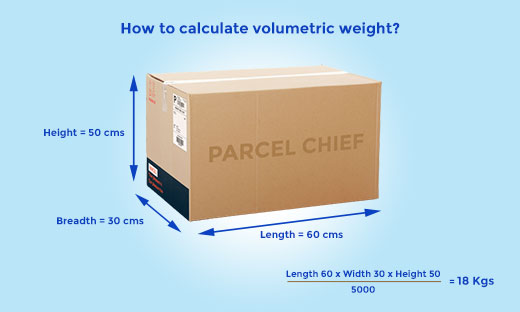
How to manually calculate volumetric weight
1) Measure three dimensions of the box (length, width, height) and multiply them.
2) If you have measured the dimensions in centimetres, then attain the result by dividing by 5000 (with EU economy services divide by 4000)
3) When your scale of measurement is in inches, then get the result by dividing by 305 (with EU economy services divide by 245)
4) The outcome of this calculation is the volumetric weight of your box.
After comparing the volumetric weight to the actual weight of the box, the courier will take the higher side from the two as chargeable weight (this is also known as billable weight).
How To Reduce The Volumetric Weight Of Your Parcel?
While packing, make sure that the box is not bulging out from any side. Always use a right size box to pack your items. If you have bulky things, like a quilt, pillow, teddy bear, etc, vacuum pack them - this will save a lot of space. Do not leave any loose space inside the box - so it doesn’t swell in transit.
Trusted by Thousands: Read What Parcel Chief Customers Say!
We love showcasing our customer reviews because that instills trust and transparency in our process. Check out some of them!
FAQs - Frequently Asked Questions
In not all cases you’d end paying more than your box’s actual weight, when you do, it’s because the carrier has found that the volumetric weight of the box is higher than your actual weight. Thus, you will invoice accordingly.
There’s a scope to dispute volumetric weight. To challenge, you may require producing the photographs of boxes when you’ve measured them. More often than not, carrier presents the accurate details of volume weight as they measure using the scanners.
The major factor of such a difference is the swelling of the box in transit to hub. This is either because you must have re-used a box or packed items loosely. So pack things correctly with fresh double-walled boxes.
The carrier may charge a penalty if undisclosed dimensions exceed their specified size limit. However, even if the dimensions are below their stipulated specification, you may end up paying on volume or you may opt for it to be sent back to you - for which you have to pay. This transaction will be a complete train wreck, so it’s recommended to share the box dimensions with the carrier.
Need More Help?

List of Prohibited Items

Important Custom Advice

Helpful Packaging Advice

Volumetric Weight

Know Your Transit Times